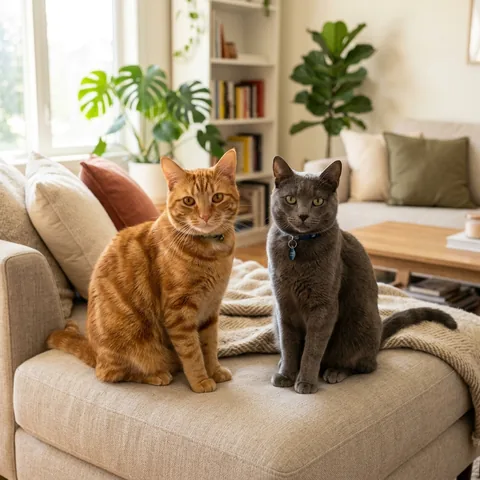
The Dream vs. The Reality of a Two-Cat Household
Adopting a second cat is an exciting milestone. You imagine your resident cat and the newcomer immediately curling up together in a sunbeam, grooming each other, and playing chase around the living room.
However, the reality of feline behavior is often quite different. Cats are highly territorial, solitary hunters by nature. To your resident cat, a new feline isn't a playmate—they are an intruder invading their territory, competing for resources, and threatening their sense of security.
If you simply bring a new cat home and release them into the living room, you are setting yourself up for hissed standoffs, territorial spraying, or physical fights that can leave permanent emotional scars.
The secret to a peaceful multi-cat home is a slow, structured introduction process. In this comprehensive guide, we'll walk you through the science-backed introduction timeline, phase-by-phase goals, and the critical mistakes you must avoid.
The Science of Feline Territory
To successfully introduce two cats, you must think like a cat. Cats rely heavily on their sense of smell to interpret the world. Every home has a "communal scent profile"—a mixture of the resident cat's pheromones, your scent, and household odors.
When a new cat enters, they bring a foreign scent that disrupts this delicate balance. Your resident cat's immediate reaction is fear and defensiveness.
By separating the cats initially, you prevent visual triggers and allow their scents to slowly integrate. This builds a shared scent profile, signaling to both cats that the other is a safe, familiar part of the household rather than a threat.
The 5-Phase Cat Introduction Timeline
There is no fixed schedule for introducing cats; every pair moves at their own pace. Some cats integrate in ten days, while others take several weeks or months. Use the timeline below as a behavioral guide, only moving to the next phase when both cats show signs of calm.
Phase 1: Base Camp Setup (Days 1–3)
Before bringing your new cat home, prepare a designated isolation room, often called "Base Camp." This should be a spare bedroom, office, or bathroom equipped with all essentials:
- A litter box (kept away from food/water)
- Food and water bowls
- Scratching posts and toys
- Comfortable bedding and hiding spots
The Goal: Give the new cat a safe, confined space to decompress after the stress of shelter life and transport. Meanwhile, your resident cat maintains run of the rest of the house.
What to avoid: Do not let the cats see each other. Keep the door closed at all times.
Phase 2: Scent Swapping (Days 4–6)
Once the new cat is eating regularly and acting confident in Base Camp, it's time to start exchanging scents.
- Item Swapping: Rub a clean towel or sock gently along the cheeks and forehead of one cat (where their scent glands are located) and place it in the other cat's territory. Observe their reaction. Hissing or growling at the item means they need more time; sniffing and walking away or rubbing against it is a positive sign.
- Room Swapping: Confine your resident cat to a room for a couple of hours and allow the new cat to explore the rest of the house. This lets the new cat leave their scent in the main living space and sniff the resident cat's territory. Swap them back when finished.
The Goal: Familiarize each cat with the other's scent without the threat of physical contact.
Phase 3: Visual Association (Days 7–10)
Only proceed to this phase when both cats are calm and relaxed during scent and room swaps.
- Feed Across the Door: Place the cats' food bowls on opposite sides of the closed Base Camp door. Start a few feet away from the door, and gradually move the bowls closer with each meal. They will associate the delicious smell of food with the scent of the other cat.
- Visual Access: Introduce a temporary visual barrier, such as a mesh screen door, a baby gate stacked high, or cracking the door open slightly with a door stopper. Feed them high-value treats (like Churu lickable treats) while they can see each other. Keep sessions short (2 to 5 minutes) and positive.
The Goal: Build positive associations with the sight of the other cat.
Phase 4: Supervised Interactive Sessions (Days 11–14)
If visual sessions are going well without prolonged staring, growling, or lunging, you can allow them in the same room.
- Use Distractions: Do not just let them stare at each other. Use a wand toy to keep both cats engaged in active play, or feed them high-value treats at opposite ends of the room.
- Keep it Brief: The first session should last no more than 5 minutes. Gradually increase the time as they remain calm.
- End on a High Note: Separate them before any tension builds. You want them to remember the interaction as fun and stress-free.
The Goal: Supervised, calm co-existence in the same physical space.
Phase 5: Complete Integration (Day 15+)
Over time, you can extend their supervised sessions and slowly phase out the active distractions. Eventually, when they show positive body language (tail held high in a question mark shape, relaxed ears, mutual sniffing, or ignoring each other), you can leave them unsupervised.
The Goal: Safe, unsupervised access to the entire home.
5 Critical Mistakes to Avoid
Even with the best intentions, it's easy to make mistakes that derail your progress. Avoid these common pitfalls to keep your cats on track:
1. Rushing the Timeline
The most common mistake is assuming that because the cats haven't fought through the door, they are ready to meet face-to-face. Rushing the process can trigger a severe territorial fight, forcing you to start all the way back at Phase 1. Patience is your greatest tool.
2. Not Having Enough Resources (The N+1 Rule)
Resource guarding is a major source of multi-cat tension. Cats need their own space and belongings. Always follow the N+1 rule for resources:
- Litter Boxes: You need one box per cat, plus one extra. For two cats, you need 3 litter boxes distributed in different rooms.
- Feeding Stations: Separate food and water bowls so cats don't have to eat shoulder-to-shoulder.
- Vertical Space: Provide multiple cat trees, window perches, and shelves. Vertical space increases the perceived size of their territory, allowing cats to share a room without being in each other's path.
3. Punishing Negative Behaviors
Hissing, growling, and swatting are normal feline communication methods. They are saying, "You're too close, back off." If you yell at or spray a cat with water for hissing, they will associate that punishment with the other cat, worsening their relationship. Instead, calmly separate them and increase the distance between them.
4. Forcing Physical Contact
Never pick up one cat and force them near the other. This makes them feel trapped, which can trigger redirected aggression toward you or extreme fear toward the other cat. Let all interactions happen naturally, at their own height and distance.
5. Ignoring Passive Aggression
Cat aggression isn't always loud and violent. Passive aggression is common and can be just as stressful:
- Staring: A cat blocking a hallway or litter box simply by sitting and staring intently at the other.
- Resource Guarding: Sleeping on the only cat tree to prevent the other from using it.
Ensure you have multiple pathways and exit routes in your home design so no cat can easily trap another.
Head-to-Head: Ready for the Next Stage?
Use this quick checklist to evaluate if your cats are ready to move from one phase to the next.
| Current Phase | Action / Test | Sign of Readiness | What to Do Next |
|---|---|---|---|
| —- | —- | —- | —- |
| Phase 1: Separation | Sniffing at the bottom of the Base Camp door. | No growling or hissing at the door; calm body posture. | Move to Phase 2: Scent Swapping. |
| Phase 2: Scent Swapping | Presenting a scented towel or sock. | Curiously sniffing the item, rubbing cheeks on it, or ignoring it. | Move to Phase 3: Visual Association. |
| Phase 3: Visual Association | Staring through a baby gate or screen. | Eating treats comfortably within sight; slow blinking; relaxed ears. | Move to Phase 4: Supervised Play. |
| Phase 4: Supervised Play | Sharing the same room for 15+ minutes. | Playing with toys independently; grooming themselves; ignoring each other. | Move to Phase 5: Complete Integration. |
The Golden Rule: Patience Wins the Day
Introducing a second cat is a marathon, not a sprint. Do not get discouraged by minor setbacks. If the cats have a tense encounter, simply take one step back in the timeline for a day or two before trying again.
By respecting their territorial instincts, providing ample resources, and moving at their pace, you will build a solid foundation of trust. In time, your cats will find their balance, and you'll enjoy a harmonious, peaceful multi-cat home.
Have you recently introduced a new cat to your household? Which phase was the most challenging for your felines? Share your experiences in the comments below!