Your Cat Isn't Being a Jerk (Probably)
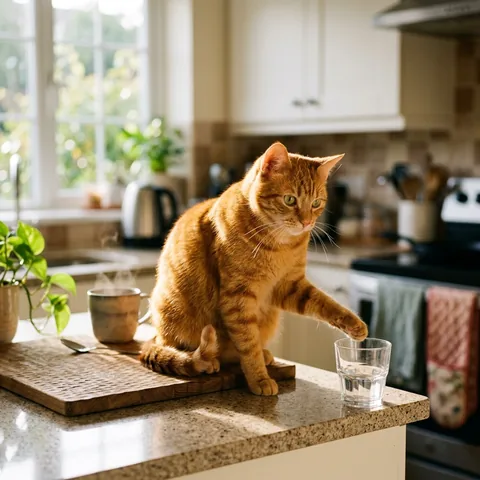
You set a water glass on the nightstand. Your cat locks eyes with you, slowly extends a paw, and nudge — crash. Glass on the floor. Water everywhere. And there sits your cat, staring down at the wreckage with zero remorse.
If this scene plays out in your house on a weekly (or daily) basis, you are not alone. Knocking objects off surfaces is one of the most universally recognized cat behaviors. It is also one of the most misunderstood.
Most owners assume their cat is being spiteful, attention-seeking, or just plain destructive. But the truth is far more interesting. This behavior is deeply rooted in feline hunting instincts, sensory exploration, and environmental needs. Let's break down the five real reasons your cat sends your belongings flying.
1. Prey Testing: The Hunter's Poke
Cats are ambush predators. In the wild, a cat encountering an unfamiliar small object — a beetle, a mouse, a leaf — doesn't immediately pounce. Instead, it does something remarkably similar to what your cat does on the countertop: it taps the object with its paw to see if it moves.
This "prey testing" behavior is hardwired into your cat's brain. When your cat bats at a pen, a bottle cap, or your earbuds, they are running an instinctive diagnostic:
- Does it move? Potential prey. Chase it.
- Does it make noise? Interesting. Investigate further.
- Does it fall and bounce? Even better. Now it is a moving target on the ground.
Your nightstand is basically a buffet of potential "prey items" from your cat's perspective. Every small object is worth testing.
2. Tactile Exploration: Paws as Sensory Organs
Cat paw pads contain an extraordinary density of mechanoreceptors — nerve endings that detect pressure, texture, vibration, and temperature. In fact, a cat's paw pads are among the most sensitive touch receptors in the entire animal kingdom.
When your cat touches an object, they aren't just pushing it — they are reading it. They are gathering information about:
- Weight: How heavy is this? Can I move it?
- Temperature: Is this warm (alive) or cold (inert)?
- Texture: Is it smooth, rough, soft, or hard?
- Stability: Does it wobble? Does it slide?
This tactile investigation explains why cats are drawn to specific objects. A lightweight pen that rolls is far more stimulating to investigate than a heavy ceramic vase that doesn't move. Your cat is essentially a tiny scientist running physics experiments on your possessions.
3. Gravity Fascination: Learning Cause and Effect
Cats are among the few non-primate animals that demonstrate a clear understanding of object permanence — they know that an object continues to exist even when they can no longer see it. Researchers at Kyoto University found that cats also have basic expectations about how gravity should work.
When your cat pushes an object off the table, they are observing the cause-and-effect chain:
- I push it → it moves.
- It reaches the edge → it falls.
- It falls → it makes a sound.
- It hits the ground → it bounces, rolls, or shatters.
Each step provides novel sensory feedback. And unlike a toy that sits in the same spot every day, a falling object creates a unique, unpredictable event every time. For an indoor cat with limited stimulation, this is genuinely entertaining.
4. Attention Seeking: The Learned Behavior Loop
Here is where your reaction matters — a lot.
Think about what happens when your cat knocks your phone off the nightstand at 3 AM:
- Your cat pushes the phone.
- You wake up, gasp, or shout "No!"
- You get out of bed to pick it up.
- You look directly at your cat.
Congratulations — you just rewarded the behavior with exactly what your cat wanted: your attention. Cats are expert pattern recognizers. It only takes two or three repetitions of this cycle before your cat learns that pushing things off surfaces is the fastest way to make you engage with them.
This is especially common in cats who are:
- Under-stimulated — not getting enough daily interactive play.
- Hungry — it is 5 AM and the food bowl is empty.
- Lonely — you have been working at your desk all day without acknowledging them.
If your cat only knocks things off when you are in the room (and never when you are away), attention-seeking is almost certainly a factor.
5. Territory Patrol: Clearing the Perimeter
Cats are territorial animals who regularly patrol their home range. In the wild, this means walking the perimeter of their territory, re-scenting marking posts, and inspecting anything new or out of place.
Your cat's elevated patrol route includes countertops, shelves, mantels, and desks. When they encounter objects that weren't there before — or objects that have been moved — they investigate by touching, sniffing, and yes, pushing them.
From your cat's perspective, they are not "messing up your stuff." They are performing a security audit of their territory. Anything unfamiliar gets tested, and if it is light enough to move, it gets relocated (usually to the floor).
How to Redirect the Behavior (Without Punishment)
You cannot — and should not — try to eliminate this behavior entirely. It is natural, instinctive, and mentally stimulating for your cat. Instead, redirect it:
Increase Daily Play Sessions
The single most effective fix. A cat who gets 15 to 20 minutes of vigorous interactive play twice a day (wand toys, laser pointers, feather teasers) is significantly less likely to entertain themselves by clearing your shelves.
Provide Puzzle Feeders and Foraging Toys
If your cat is knocking things over out of boredom, give them something constructive to manipulate. Puzzle feeders, treat-dispensing balls, and snuffle mats satisfy the same tactile and problem-solving needs without sacrificing your water glasses.
Secure Valuable Items
This sounds obvious, but it works. Use museum putty or adhesive strips to secure fragile items on shelves. Keep glasses and phones away from edges. If your cat has a specific surface they love to clear, accept that surface as "cat territory" and remove breakables.
Don't React
This is the hardest one. When your cat pushes something off the table in front of you, do not look at them, do not yell, and do not rush over. Wait 30 seconds, then quietly pick it up. If you remove the attention reward, the learned behavior will gradually fade (though the instinctive prey-testing will continue).
Add Vertical Enrichment
Cat shelves, window perches, and tall cat trees give your cat elevated spaces to patrol without needing to use your counters and desks. The more "approved" high ground they have, the less likely they are to patrol your bookshelf.
When to Be Concerned
In most cases, knocking things off tables is completely normal behavior. However, if your cat suddenly starts compulsively pushing objects, pacing, or showing repetitive behaviors they did not exhibit before, it could signal:
- Anxiety or stress from environmental changes (new pet, new baby, recent move).
- Cognitive dysfunction in senior cats (feline dementia).
- Hyperthyroidism, which can cause hyperactivity and restlessness in older cats.
If the behavior is new, excessive, or accompanied by other changes (appetite loss, litter box avoidance, vocalization changes), consult your veterinarian.
The Bottom Line
Your cat is not trying to ruin your life. When they knock your coffee mug off the counter, they are following millions of years of predatory instinct, exploring their environment through the incredible sensitivity of their paw pads, and occasionally — yes — trying to get you to pay attention to them.
Instead of fighting the behavior, work with it. Give them toys to bat, puzzles to solve, and vertical spaces to patrol. Save your breakables, invest in a good wand toy, and appreciate the fact that you live with a tiny, furry physicist who never gets tired of testing gravity.
Does your cat have a favorite item to knock off the table? We'd love to hear your stories in the comments!