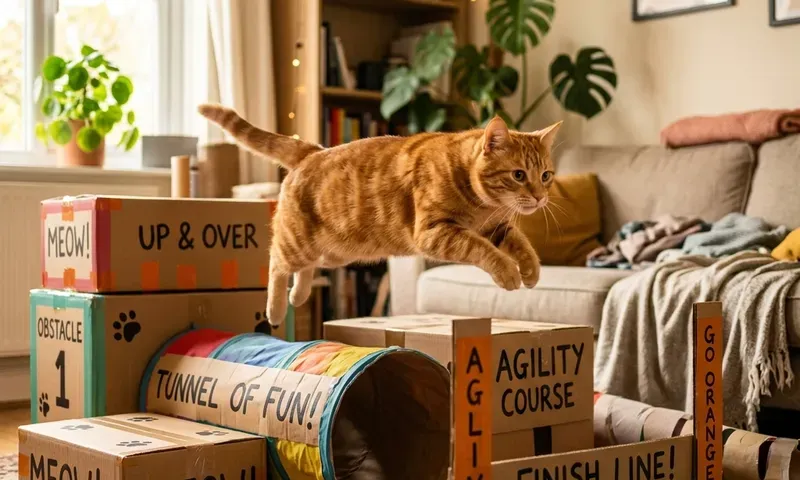
Your cat does zoomies at 3 AM, knocks things off shelves for fun, and has turned your curtains into a climbing wall. Sound familiar? That's an under-stimulated cat screaming for enrichment. An indoor cat agility course channels all that chaotic energy into structured, healthy exercise — and you can build one with stuff you already have at home.
Why Your Indoor Cat Needs an Agility Course
Indoor cats live longer than outdoor cats on average (12–18 years vs. 2–5 years), but they face a different set of health risks: obesity, boredom, and behavioral issues. The Association for Pet Obesity Prevention reports that 60% of U.S. cats are overweight or obese — largely due to inactivity.
A cat agility course solves multiple problems at once:
- Physical exercise: Jumping, climbing, and running burn calories and maintain muscle tone
- Mental stimulation: Learning to navigate obstacles keeps your cat's brain sharp
- Bonding: Training sessions strengthen the bond between you and your cat
- Behavioral improvement: A tired cat is a well-behaved cat. Agility work reduces destructive behavior, nighttime zoomies, and aggression
You don't need professional equipment. Everything below can be built with household items for under $20 — or free.
Before You Start: Understanding Cat Training
Cats aren't dogs. They won't do something just because you asked nicely. Cat agility training works on one principle: making the desired behavior more rewarding than the alternative. Here's how:
- Use high-value treats. Regular kibble won't cut it. Use freeze-dried chicken, Churu lickable treats, or small pieces of cooked salmon
- Keep sessions short. 3–5 minutes maximum. Cats lose interest fast. End on a success
- Never force. If your cat walks away, session's over. Try again tomorrow
- Use a target stick. A chopstick with a small ball on the end works perfectly. Teach your cat to follow the target first — this becomes your steering wheel for the agility course
- Click and treat. A clicker (or a consistent mouth click) marks the exact moment your cat does the right thing
The 8 DIY Agility Obstacles
1. The Tunnel Run
What you need: A collapsible play tunnel ($8–12), or make one from cardboard boxes with the flaps cut off and taped together end-to-end.
How to train it: Start with a short tunnel (one box length). Toss a treat through so your cat can see it land on the other side. Most cats will walk through immediately. Gradually extend the tunnel length. Add a curve once your cat is comfortable with straight runs.
This taps into your cat's natural love of enclosed spaces — the tunnel feels safe while adding the thrill of movement.
2. Hurdle Jumps
What you need: Broom handles, wrapping paper tubes, or PVC pipes balanced on stacks of books or shoe boxes.
How to train it: Start with the bar on the floor. Lure your cat across it with a treat or target stick. Once they're walking over it confidently, raise it 2 inches at a time. Most healthy adult cats can comfortably clear 12–18 inches. Never go higher than your cat's shoulder height.
Safety note: The bar should fall easily if bumped. Never secure it in place — if your cat misjudges the jump, a rigid bar could cause injury. Balanced loosely on supports is perfect.
3. Weave Poles
What you need: 4–6 plastic water bottles filled with sand or rice (for stability), spaced about 18 inches apart in a line.
How to train it: Use your target stick to guide your cat in an S-pattern through the bottles. This is the hardest obstacle for most cats — expect it to take 1–2 weeks of short daily sessions before they get fluid. Start with just 2 poles and add more as your cat understands the pattern.
4. Platform Hopping
What you need: Sturdy boxes, small stools, or stacked books at varying heights. A multi-level cat tree works perfectly as the centerpiece.
How to train it: Arrange 3–4 platforms in a stepping-stone pattern. Lure your cat from platform to platform with treats. Start close together and gradually increase the gaps. This builds coordination, confidence, and rear-leg strength — especially important for older cats losing mobility.
5. The Balance Beam
What you need: A wooden plank (2x6 or 2x8 lumber, 4–6 feet long) supported on two cinder blocks, bricks, or sturdy boxes. Keep it low — 6–8 inches off the ground maximum.
How to train it: Cats are natural balancers, so most take to this quickly. Place treats along the beam to encourage your cat to walk its length. Wrap the plank in sisal rope or carpet scraps for better traction. Once your cat is confident, they'll start running across it.
6. The Hoop Jump
What you need: A hula hoop, an embroidery hoop, or make one from a wire clothes hanger bent into a circle.
How to train it: Hold the hoop touching the floor with the opening facing your cat. Lure them through with a treat. Gradually raise the bottom edge off the floor — 1 inch per session. Most cats will happily jump through a hoop held 8–12 inches off the ground. The key is incremental height increases so your cat never fails.
7. The A-Frame Ramp
What you need: Two pieces of plywood (2–3 feet long) leaned together like a tent, or two ironing boards at a low angle.
How to train it: Start with a very shallow angle (almost flat). Place treats going up one side and down the other. As your cat gains confidence, increase the angle. Add carpet strips or shelf liner for traction. This builds core strength and teaches your cat to manage inclines — useful for navigating cat trees and furniture.
8. The Treat Puzzle Station
What you need: A muffin tin with treats hidden under tennis balls, a cardboard box with holes cut in the top, or a toilet paper roll puzzle (fold the ends closed with a treat inside).
How to use it: Place this at the end of the agility course as the grand reward. Your cat completes the obstacles and finishes with a foraging challenge. This mimics the natural hunt-catch-eat sequence that keeps cats mentally satisfied. It works on the same principle as puzzle feeders — making mealtime engaging rather than passive.
Designing Your Course Layout
Your course doesn't need to be permanent or fill an entire room. Here's a practical layout for a hallway or living room:
- Start: Platform hop (3 boxes, ascending height)
- Straight: Tunnel run (3–4 feet)
- Turn: Weave poles (4 bottles)
- Straight: 2 hurdle jumps (8–12 inches)
- Turn: Hoop jump
- Finish: Balance beam to treat puzzle station
Total space needed: approximately 8–12 feet of linear space with turns. An L-shaped hallway is ideal. You can set it up and break it down in 5 minutes once you have a system.
Training Schedule That Works
Don't try to introduce everything at once. Follow this 4-week progression:
- Week 1: Target stick training + tunnel only. 2–3 sessions per day, 3 minutes each
- Week 2: Add hurdle jumps (start on the floor). Continue tunnel
- Week 3: Add weave poles and platform hops. Link 2–3 obstacles together
- Week 4: Full course runs. Add hoop jump and balance beam. Time your runs for fun
After 4 weeks, most cats will run the full course independently when they see you setting it up. The key is consistency over intensity — short, daily sessions beat long, occasional ones every time.
Cats That Shouldn't Do Agility
Check with your vet before starting an agility program if your cat:
- Is over 10 years old with no recent mobility assessment
- Has joint issues, arthritis, or hip dysplasia
- Is significantly overweight (start with diet changes and low-impact play first)
- Has heart conditions or breathing issues
- Is recently declawed (reduced grip affects jumping safety)
For senior cats or cats with mobility limitations, focus on low-height obstacles, ramps instead of jumps, and puzzle stations. Any level of enrichment is better than none.
Level Up: Competitive Cat Agility
Yes, competitive cat agility is a real thing. The International Cat Agility Tournaments (ICAT) hosts events across the U.S. where cats navigate standardized courses. Cats are judged on speed and accuracy, and all breeds (including mixed breeds) are welcome.
But even if you never compete, training your cat on an agility course transforms your relationship. You're giving your cat a job to do — and cats with jobs are healthier, calmer, and more engaged than cats left to entertain themselves.
The Bottom Line
An indoor cat agility course costs little to nothing, takes 10 minutes to set up, and addresses the three biggest challenges of indoor cat ownership: obesity, boredom, and behavioral issues. You don't need fancy equipment — cardboard boxes, broomsticks, and water bottles are all you need to start.
The investment isn't money. It's 5 minutes a day of training. In return, you get a healthier, happier, more engaged cat — and significantly fewer 3 AM zoomie sessions.
For more ways to create the ultimate indoor environment, check out our Complete Indoor Cat Setup Guide and our picks for the best cat trees that double as agility centerpieces.