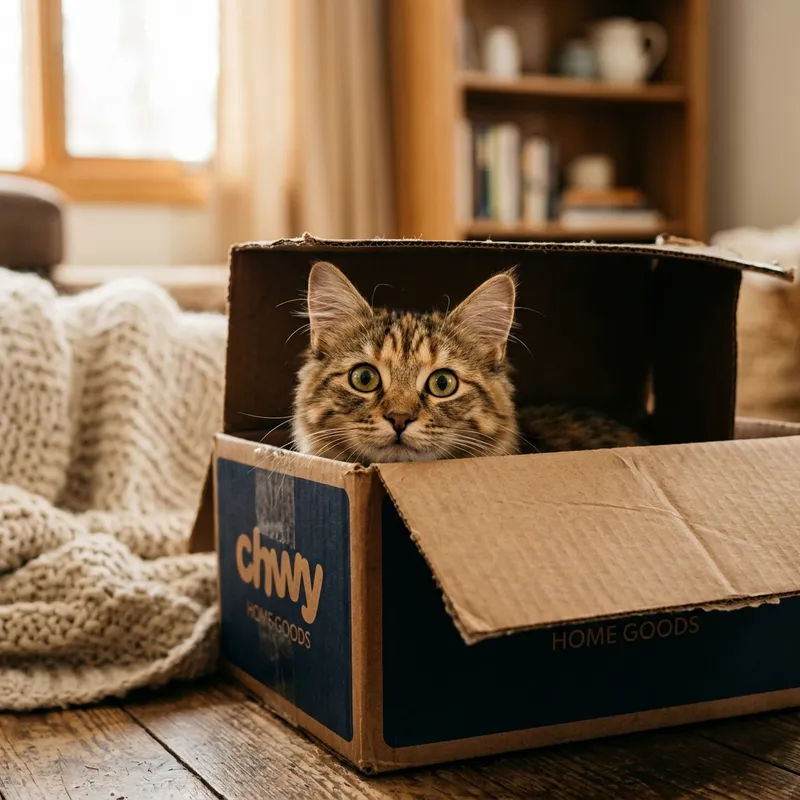
You spend hundreds on cat furniture, and your cat ignores it for a cardboard Amazon box. Sound familiar? You're not alone. The "cats and boxes" phenomenon is one of the most studied behaviors in feline science — and the reasons behind it go far deeper than you'd expect.
1. Boxes Reduce Stress (Proven by Science)
A landmark 2014 study from the University of Utrecht gave shelter cats access to hiding boxes. The result? Cats with boxes showed significantly lower stress levels within 3 days compared to cats without boxes, who took over 14 days to reach the same baseline.
Why? Cats are ambush predators by nature. They don't confront threats — they avoid them. A box provides an instant "safe zone" where no predator can sneak up from behind or the sides. Even in a safe home with no predators, this instinct remains hardwired.
Practical takeaway: If you've just moved, adopted a new cat, or introduced a new pet, put out several open boxes around the house. This simple act dramatically reduces transition stress.
2. Thermoregulation: Boxes Are Warm
According to a 2006 study by the National Research Council, the thermoneutral zone for domestic cats is 86–97°F (30–36°C) — significantly warmer than the average home. Most houses sit at 68–72°F, meaning your cat is perpetually slightly cold by their own standards.
Cardboard is an excellent insulator. When a cat curls up in a box, the enclosed space traps their body heat and creates a warm microenvironment closer to their preferred temperature. This is the same reason cats seek out:
- Sunny windowsills
- Laptop keyboards (warm from the processor)
- Your lap
- Freshly dried laundry
A box just happens to be the most efficient heat-trapping shape. A tall cat tree near a window gives them warmth and height — the ultimate combo.
3. Ambush Instinct: The Perfect Hunting Blind
Even well-fed house cats retain their predatory wiring. A box is the perfect ambush point — your cat can see out (through the opening) while remaining hidden. Watch a cat in a box: they'll fixate on movement outside the opening, their pupils will dilate, and they'll pounce on anything that passes by.
This behavior is play-hunting, which is essential for mental health. Cats who don't get enough predatory play can develop behavioral issues like aggression, anxiety, or destructive scratching. The box facilitates this instinct naturally.
4. Conflict Avoidance in Multi-Cat Homes
In multi-cat households, boxes serve as conflict diffusers. Cats lack complex conflict resolution strategies — unlike dogs, they don't have a wide range of facial expressions or reconciliation behaviors. Their primary strategy is avoidance.
A box allows a cat to physically remove itself from social tension without leaving the room entirely. Studies in animal shelters have shown that providing boxes in group housing reduces inter-cat aggression by up to 50%.
If you have multiple cats and notice tension, add more boxes and hiding spots. Same principle as setting up a proper indoor cat environment — more vertical and enclosed spaces means fewer territorial disputes.
5. Texture Satisfaction: The Joy of Cardboard
Cats don't just sit in boxes — they chew, scratch, and shred them. Cardboard provides a satisfying texture that mimics tree bark, which wild cats scratch to maintain their claws, mark territory (via scent glands in their paws), and stretch their muscles.
The resistance level of corrugated cardboard is close to ideal for claw maintenance. It's firm enough to catch claws but soft enough to shred satisfyingly. This is why cardboard scratching pads are among the most popular cat products — they tap into the same instinct that makes boxes irresistible.
6. Novel Scent Investigation
Every box arrives carrying scents from its journey — warehouses, delivery trucks, other packages. Cats have approximately 200 million olfactory receptors (compared to our 6 million). A new box is essentially an olfactory newspaper delivering information about the outside world.
This is why cats often immediately investigate a new box, rubbing their cheeks on the edges (depositing their own scent glands to claim it), before climbing inside. Once they've scent-marked it, the box becomes "theirs" — a personalized safe space.
7. It's Simply Fun
Not every behavior needs a deep evolutionary explanation. Cats are curious, playful animals, and a box is a novel object that changes the room's geography. It's something to explore, hide in, leap out of, and bat around. Enrichment is enrichment.
In fact, behavioral researchers classify box play as a key form of environmental enrichment — the kind of stimulation that keeps indoor cats mentally sharp and emotionally balanced. Other enrichment options include cat trees with multiple levels, puzzle feeders, and water fountains that stimulate natural drinking behavior.
What Type of Box Do Cats Prefer?
Research and observation show clear preferences:
- Size: Just big enough to fit their body when curled up. Cats prefer snug boxes over roomy ones (more body heat, more security)
- Material: Corrugated cardboard wins over smooth cardboard, plastic, or fabric
- Openings: One opening preferred over multiple. Cats want to face one direction with their back protected
- Elevation: A box placed on a shelf or table gets more use than one on the floor — height = safety in cat logic
- Freshness: New boxes get more attention than old ones. Rotate boxes every few weeks to maintain novelty
When Box Obsession Signals a Problem
A cat that enjoys boxes is normal. A cat that never leaves a box may be signaling something else:
- Excessive hiding — If your cat hides in a box for most of the day, refusing to come out for meals or play, they may be experiencing chronic stress, pain, or illness
- New hiding behavior — A previously social cat that suddenly starts hiding constantly should see a vet. Cats hide pain instinctively
- Aggression when disturbed — A cat that lashes out when you approach their box may be guarding due to fear, not just preference
These behaviors warrant a vet visit to rule out underlying health issues.
How to Channel This Instinct
Understanding why cats love boxes helps you design a better living environment:
- Leave delivery boxes out for a few days before recycling. Free enrichment
- Invest in enclosed cat furniture — Cat trees with cubbies provide the same security as a box, but they're permanent, elevated, and designed for claw maintenance
- Use boxes during transitions — Moving? New baby? New pet? Boxes in multiple rooms reduce stress significantly
- Consider enclosed litter boxes — Many cats prefer covered litter boxes for the same reason they love boxes: security and privacy. Our open-top vs. covered guide breaks down the pros and cons
The Bottom Line
Cats love boxes because they're warm, safe, and stimulating. It's not weird. It's deeply rational behavior shaped by millions of years of evolution. The instinct to seek enclosed spaces for security, warmth, and ambush positioning is hardwired into every domestic cat's brain.
Instead of fighting it, embrace it. Leave out boxes, invest in furniture with enclosed spaces, and understand that your $300 cat tree competes with a free Amazon box — and sometimes loses. That's just cat ownership.
Want to learn more about creating the perfect indoor environment? Our Complete Indoor Cat Setup Guide covers everything from territory design to enrichment strategies.