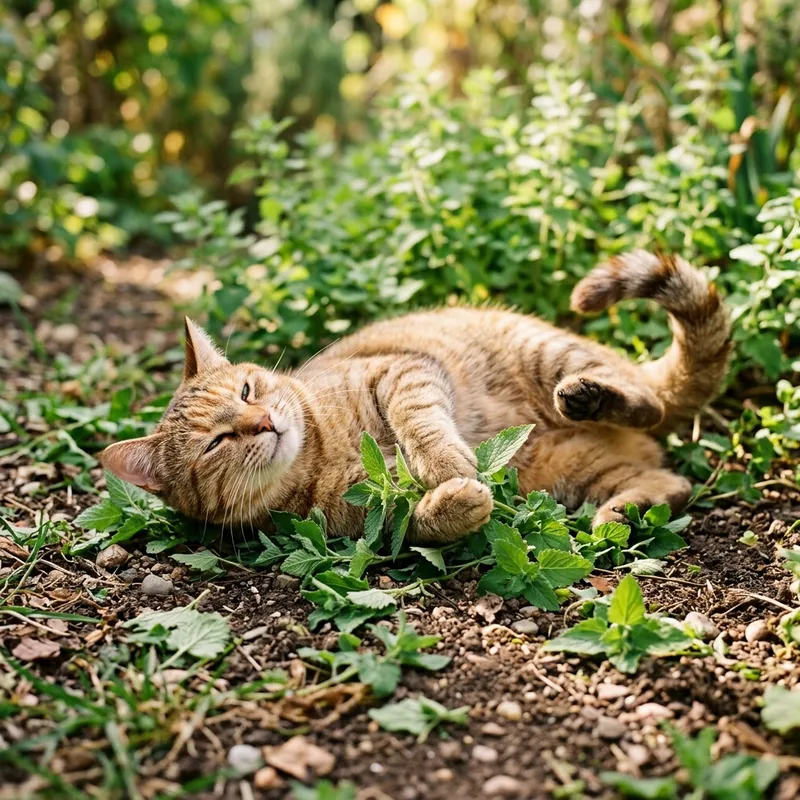
Your cat takes one sniff of that little green plant and transforms into a rolling, drooling, purring maniac. Five minutes later, they're completely normal again. What just happened? The answer involves fascinating chemistry, genetics, and evolutionary biology.
What Is Catnip, Exactly?
Catnip (Nepeta cataria) is a member of the mint family, native to Europe and Asia but now growing wild across North America. It's a perennial herb that reaches 2–3 feet tall with heart-shaped leaves and small white or purple flowers.
The plant has been documented affecting cats since at least the 1700s, but scientists only identified the active chemical compound in 1941: nepetalactone.
The Chemistry: How Nepetalactone Works
Nepetalactone is a volatile terpenoid oil found in the microscopic bulbs on the surface of catnip leaves and stems. When these bulbs rupture (from a cat biting, rubbing, or crushing the plant), nepetalactone is released into the air.
When a cat inhales nepetalactone, here's what happens in the brain:
- Nasal binding: Nepetalactone molecules bind to receptors in the cat's nasal tissue
- Olfactory signal: These receptors send signals to the olfactory bulb in the brain
- Amygdala activation: The signal reaches the amygdala (emotional processing center) and hypothalamus (behavioral regulation)
- Neurochemical release: The brain releases a cascade of feel-good chemicals that produce a temporary euphoric state
A 2021 study published in Science Advances by researchers at Iwate University in Japan discovered that the response also activates the μ-opioid system — the same reward pathway triggered by morphine in humans. However, nepetalactone is not addictive and produces no withdrawal symptoms.
What Does the "Catnip High" Look Like?
The typical catnip response includes one or more of these behaviors, lasting 5–15 minutes:
- Rubbing and rolling: Cats roll on their backs, rub their face and body against the catnip
- Purring and drooling: Signs of pleasure and relaxation
- Zooming: Sudden bursts of hyperactive running and jumping
- Bunny kicking: Grabbing catnip toys with front paws and kicking with back legs (play-hunting behavior)
- Vocalizations: Meowing, chirping, or growling at the catnip
- Glazed eyes and "spaced out" look: The euphoric state
After the initial response, cats enter a refractory period of about 30 minutes to 2 hours, during which they're immune to catnip's effects. Then sensitivity resets.
Not All Cats Respond to Catnip
Here's a fact that surprises most cat owners: 30–50% of cats show no response to catnip at all. The sensitivity is genetic — it's inherited as an autosomal dominant trait. A cat either has the gene or doesn't.
Other factors that determine response:
- Age: Kittens under 3–6 months don't respond. The sensitivity develops as they mature sexually
- Genetics: The catnip response gene is inherited. If neither parent responded, the kitten won't either
- Species: The response isn't limited to domestic cats. Lions, tigers, leopards, and jaguars also respond to nepetalactone
- Individual variation: Even among responsive cats, intensity varies — some get mildly relaxed, others go full zoomies
Is Catnip Safe?
Yes, completely. Catnip is non-toxic, non-addictive, and cats naturally self-regulate their intake. There is no documented case of catnip causing lasting harm to a cat.
Some clarifications:
- Eating it is safe: Ingesting small amounts can produce a mild sedative effect (the opposite of the stimulating inhaled response)
- Overconsumption: A cat that eats too much may vomit or have mild diarrhea — this is self-limiting and harmless
- Not addictive: Despite the opioid receptor connection, nepetalactone does not create dependency. Cats don't seek it compulsively
- Safe for daily use: Offering catnip once a day is perfectly fine. Many veterinary behaviorists recommend it as enrichment
Catnip Alternatives for Non-Responders
If your cat doesn't respond to catnip (or you want variety), several alternative plants produce similar effects through different chemical pathways:
| Plant | Active Compound | Response Rate | Safe? |
|---|---|---|---|
| Catnip | Nepetalactone | 50–70% | ✓ |
| Silver vine | Actinidine | ~80% | ✓ |
| Tatarian honeysuckle | Unknown | ~50% | ✓ |
| Valerian root | Actinidine | ~47% | ✓ |
Silver vine (from Asia) is particularly interesting because it affects many cats that don't respond to catnip. A 2017 study in BMC Veterinary Research found that 75% of cats who didn't respond to catnip did respond to silver vine.
Best Ways to Use Catnip
Maximize the enrichment value:
- Sprinkle on scratching posts: Encourages healthy scratching behavior and saves your furniture
- Stuff in toys: Catnip-filled mice and kicker toys encourage play-hunting, providing exercise and mental stimulation
- In a new environment: Sprinkle catnip on a new cat tree or scratching post to encourage exploration
- During training: Use as a positive reward for carrier training or nail trimming sessions
- In the litter area: A small amount near (not in) the litter box can reduce stress around litter box transitions. If you're transitioning to an automatic litter box, a light sprinkle nearby can help
Storage tip: Keep dried catnip in a sealed container in the freezer. Nepetalactone degrades with air exposure. Frozen catnip stays potent for over a year.
The Evolutionary Puzzle
Why did cats evolve this response? The leading theory, supported by the 2021 Iwate University study, is that the behavior is actually a natural insect repellent strategy.
When cats roll on catnip, they crush the leaves and coat their fur with nepetalactone. This compound is a potent repellent against mosquitoes and other biting insects. The study showed that cats who rolled on nepetalactone had significantly fewer mosquito landings than cats without the coating.
So the "catnip high" may be nature's way of motivating cats to apply their own bug spray.
The Bottom Line
Cats like catnip because the chemical nepetalactone triggers a temporary euphoric response through the brain's opioid receptors. It's completely safe, non-addictive, and may have evolved as a natural insect defense mechanism. About half of all cats are genetically wired to respond, and silver vine works for most of the rest.
Use it as a tool for enrichment, training, and making your cat's environment more stimulating. Combined with proper indoor cat setup, interactive toys, and quality cat furniture, catnip is one of the simplest ways to improve your cat's quality of life.