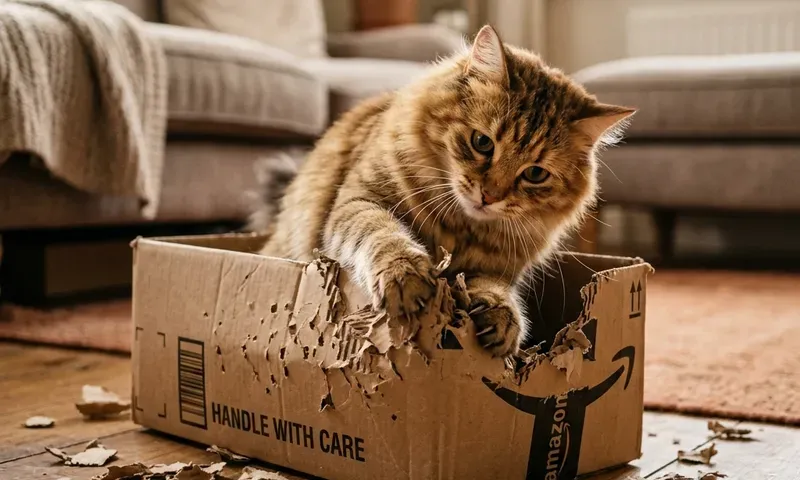
You ordered a cat bed. Your cat sleeps in the box it came in. You built a custom cat shelf. Your cat prefers the cardboard insert from the packaging. If this sounds familiar, you're experiencing one of the most universal truths of cat ownership: cats are obsessed with cardboard. Here's why.
1. Cardboard Is the Perfect Scratching Surface
Scratching is a biological necessity for cats, not a behavioral choice. They scratch to:
- Shed outer claw sheaths — Revealing sharp new claws underneath
- Mark territory — Scent glands in their paw pads leave invisible markers
- Stretch muscles — Scratching extends the tendons and muscles in their legs, shoulders, and paws
- Relieve stress — The physical action releases tension, similar to humans stretching when anxious
Corrugated cardboard has a resistance level that closely mimics tree bark — the surface wild cats evolved to scratch. It's firm enough to catch claws but soft enough to shred satisfyingly. This is why cardboard scratching pads consistently outsell sisal, carpet, and wood alternatives in consumer studies.
If your cat scratches your furniture, the fix isn't punishment — it's providing a better alternative. A cardboard scratcher placed near the targeted furniture solves the problem in most cases. Our best cat trees guide includes models with built-in cardboard scratching inserts.
2. Cardboard Retains Body Heat
Cats run warm. Their ideal ambient temperature is 86–97°F (30–36°C), well above the average home temperature of 68–72°F. This means your cat is always looking for ways to close that thermal gap.
Cardboard is an excellent thermal insulator. The corrugated structure creates air pockets that trap heat, similar to double-pane windows. When a cat lies on cardboard:
- The cardboard absorbs their body heat rather than conducting it away
- Air pockets in the corrugation create an insulating barrier from cold floors
- The surface warms quickly and stays warm longer than tile, wood, or even most fabrics
This is why cats often choose a cardboard box on a cold floor over a plush bed — the cardboard is warmer underfoot, even if it looks less comfortable to us.
3. The Texture Feels Good on Their Teeth
Have you ever caught your cat chewing on cardboard? It's not random. Cats' teeth and jaws are designed for shearing meat, and the fibrous texture of corrugated cardboard provides similar resistance. Chewing cardboard may:
- Satisfy hunting instinct: Shredding prey involves the same jaw movements
- Clean teeth: The abrasive fibers can help remove soft plaque buildup
- Provide sensory stimulation: The tearing sound and texture create a satisfying feedback loop
Note: Occasional cardboard chewing is normal and harmless. If your cat eats cardboard (swallows pieces regularly), consult your vet. This could indicate pica, a condition sometimes caused by nutritional deficiency, stress, or boredom.
4. Cardboard Carries Rich Scent Information
With 200 million olfactory receptors (compared to our 6 million), cats experience the world primarily through smell. A piece of cardboard is an olfactory treasure map.
Every cardboard item in your home carries scents from:
- Manufacturing facilities
- Delivery warehouses and trucks
- Other packages and products it was stored alongside
- The outdoors (rain, soil, vegetation from transit)
- Human handlers along the supply chain
When your cat rubs their cheeks on a new piece of cardboard, they're reading these scents and then overwriting them with their own facial pheromones. This claiming behavior transforms a novel object into something familiar and owned.
5. Cardboard Provides Environmental Enrichment
Indoor cats need mental stimulation to stay healthy. Without it, they can develop anxiety, depression, and destructive behaviors. Cardboard naturally provides several forms of enrichment:
- Novelty: Every new delivery box changes the room's geography, giving your cat something new to investigate
- Manipulability: Unlike most cat products, cardboard is destructible. Cats can modify it — shred it, reshape openings, flatten sections. This creative destruction is cognitively stimulating
- Hide-and-seek: Cardboard boxes and tubes create instant hiding spots and ambush points
- Sound feedback: The crinkle, thump, and tearing sounds provide auditory enrichment
Veterinary behaviorists consider destructible toys and surfaces (like cardboard) superior to indestructible ones because they allow cats to express natural predatory behaviors. A cat that can "kill" and shred a cardboard tube is engaging the same neural pathways as a cat catching prey.
For more ways to enrich your indoor cat's environment, our complete indoor cat setup guide covers territory design, vertical space, and enrichment strategies.
6. It's Enclosed (The Box Factor)
Cardboard's most famous form — the box — combines all of the above with the most powerful feline preference: enclosure.
Cats are evolutionarily programmed to seek enclosed spaces. A box provides:
- Security: Walls on all sides mean nothing can sneak up from behind
- Temperature: Enclosed cardboard creates a warm microenvironment
- Stress reduction: Research shows cats with boxes adapt to new environments 50% faster than cats without them
- Ambush positioning: One opening to monitor, back protected
We cover the box obsession in depth in our article on why cats love boxes, including the specific University of Utrecht study that quantified stress reduction.
How to Use Cardboard for Cat Enrichment
Instead of immediately recycling, put cardboard to work:
- Leave delivery boxes out for 3–5 days — Free enrichment that costs nothing
- Create tunnels — Connect multiple boxes with cut openings for a DIY cat playground
- Make puzzle feeders — Cut small holes in a box, put treats inside. Your cat figures out how to fish them out
- Layer flat pieces — Stack 2–3 flat cardboard pieces where your cat likes to rest. The insulation makes a warm sleeping spot
- Rotate regularly — Replace old, scent-saturated cardboard with fresh pieces to maintain novelty
- Invest in quality cardboard scratchers — Commercially designed cardboard scratching pads last months and channel scratching away from furniture
When to Be Concerned
Normal cardboard behavior includes scratching, sitting on/in, rubbing, and occasional chewing. See a vet if your cat:
- Eats large amounts of cardboard — Could indicate pica (nutritional deficiency or compulsive disorder)
- Only wants to hide in boxes and won't come out — May signal chronic stress, pain, or illness
- Chews obsessively and frantically — Possible dental pain or anxiety
The Bottom Line
Cats love cardboard because it serves nearly every one of their instinctual needs: scratching, thermal comfort, scent exploration, mental stimulation, and security. It's not a deficiency in your expensive cat products — it's a testament to how perfectly cardboard hits the intersection of what cats actually want.
The smartest approach is to combine both: invest in quality furniture like sturdy cat trees for permanent vertical territory, and supplement with free cardboard enrichment from your daily deliveries. Your cat gets the best of both worlds.